
If you suddenly find yourself questioning your career, relationship, identity, priorities, or what you want from the next part of your life, you may wonder whether you are having a midlife crisis.
But not every period of uncertainty in middle age is a crisis.
Midlife can involve normal psychological adjustment, major life stress, changing responsibilities, health changes, or a reassessment of what matters. Some people informally call this a midlife awakening, although that is not a clinical term.
The useful question is not:
“Am I having a crisis or an awakening?”
It is:
“What is changing, how much is it affecting me, and am I making decisions from clarity or distress?”
What Is a Midlife Crisis?
A midlife crisis is not an official mental-health diagnosis.
The term is generally used to describe a period of significant distress or uncertainty during middle adulthood involving areas such as:
- identity
- ageing
- relationships
- career
- health
- purpose
- missed opportunities
- future goals
Research on midlife shows that this life stage can involve both gains and challenges, rather than one universal crisis. Adults may simultaneously manage work, caregiving, aging parents, children, financial responsibilities, changing relationships, and physical changes.
So simply reaching 40, 45, or 50 does not automatically trigger a psychological crisis.
What Is a Midlife Awakening?
“Midlife awakening” is a popular self-development term rather than a psychological diagnosis.
People often use it to describe a period of reflection in which they begin questioning:
- old goals
- relationships
- career choices
- definitions of success
- expectations from family or society
- How do they want to spend the next stage of life
In psychology, it may be more accurate to describe this as a midlife transition, life review, or identity adjustment.
Identity continues to develop throughout adulthood, particularly when changing circumstances challenge how someone understands themselves.
A transition can feel uncomfortable without necessarily being unhealthy.
If this phase has left you more anxious, restless, or unable to switch off, take SoulBot’s Free Anxiety Test to reflect on how much anxiety may be affecting your daily life.
Midlife Crisis vs Midlife Transition
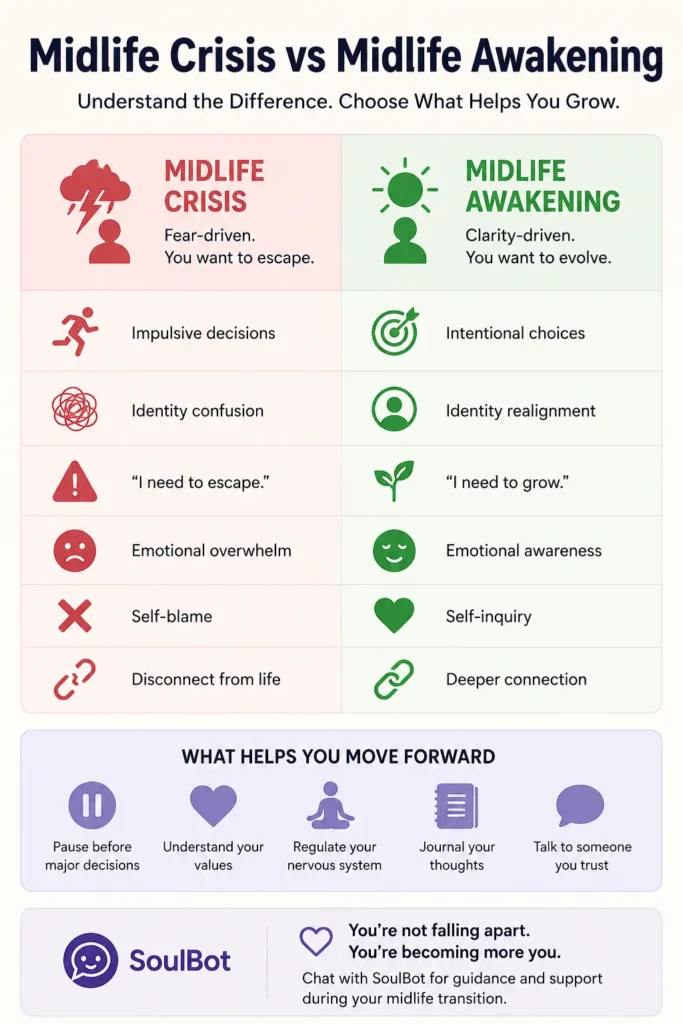
| Midlife crisis pattern | Reflective midlife transition |
|---|---|
| Strong urge to escape current life | Desire to understand what needs changing |
| Decisions made during intense distress | Changes considered over time |
| “I need to destroy everything and restart” | “Something no longer fits” |
| Persistent emotional overwhelm | Curiosity mixed with discomfort |
| Behavior becomes increasingly impulsive | Choices become more intentional |
| Daily functioning may deteriorate | Daily functioning remains relatively stable |
The distinction is not perfect. Someone can experience both reflection and distress at the same time.

What Are Common Signs of a Midlife Crisis?
Possible signs include:
- Persistent dissatisfaction with life
- Feeling trapped or restless
- Questioning your identity
- Frequent thoughts about aging or lost time
- Comparing yourself with younger people or peers
- Suddenly wanting major changes
- Withdrawing from relationships
- Increased irritability
- Difficulty enjoying achievements that once mattered
- Making unusually impulsive decisions
One or two of these experiences do not prove you are having a midlife crisis.
Look at duration, intensity, and impact.
Why Does Midlife Feel Difficult for Some People?
Midlife often brings several pressures together.
You may be dealing with:
Career questions
You may have achieved goals you spent years pursuing and suddenly ask:
“Do I actually want this?”
Or you may feel disappointed about where your career has reached.
Changing family roles
Middle-aged adults may simultaneously support children and aging parents.
That can create emotional, practical, and financial pressure. Midlife researchers specifically identify these overlapping family and work roles as important challenges during this period.
Awareness of aging
Changes in health, appearance, or physical ability can make time feel more visible.
This can lead to questions about mortality, missed opportunities, and what you still want to experience.
Relationship changes
Long-term relationships may also change as careers, parenting roles, and individual priorities evolve.
Hormonal and physical changes
For some women, perimenopause and menopause can involve sleep difficulties, low mood, anxiety, memory problems, and changes in concentration. These symptoms can sometimes overlap with what people casually describe as a midlife crisis.
Not every midlife emotional change is therefore an existential problem.
Try the SoulBot 4D Midlife Check
Before making a major life decision, check four things.
1. DISTRESS
How emotionally intense does life feel right now?
- Mild dissatisfaction?
- Persistent anxiety?
- Feeling unable to cope?
2. DURATION
How long has this been happening?
A difficult week after a stressful event is different from months of persistent dissatisfaction.
3. DECISIONS
Are you suddenly wanting to:
- Quit your job
- End a relationship
- Move somewhere new
- Spend large amounts of money
- Completely reinvent your life?
Major changes are not automatically wrong.
But ask whether you are moving toward something meaningful or simply trying to make uncomfortable feelings disappear.
4. DIRECTION
What specifically do you want more of?
- Meaning?
- Freedom?
- Connection?
- Creativity?
- Rest?
- Challenge?
If you can name what is missing, you can often make smaller changes before rebuilding your entire life.
What Should You Do During a Midlife Transition?
- Pause Major Decisions When Emotions Are High
- You do not need to freeze your life indefinitely.
- But avoid making irreversible decisions during the most emotionally intense moments.
- Give important choices time to survive different moods.
Ask:
“Would I still want this change if I felt calmer?”
Separate the Problem From Your Entire Life
Instead of:
“Everything is wrong.”
Get specific.
Maybe:
“My job no longer feels meaningful.”
or:
“My relationship needs more connection.”
or:
“I have built a life around achievement and left little time for myself.”
A specific problem is easier to work with than a global crisis.
If your body is constantly activated while you’re trying to make these decisions, first use some of the practical techniques for regulating your nervous system during stress.
Reassess Your Values
Write three lists:
- What still matters to me?
- What mattered before but doesn’t anymore?
- What have I been postponing?
Do not turn this into a demand to discover your “life purpose.”
You are simply looking for where your current life and current values no longer match.
If the bigger question is simply “I don’t know what I want anymore,” that uncertainty can also be explored without immediately forcing an answer.
Test Changes Before Making Them Permanent
Instead of:
“I need a completely different career.”
try:
- taking a course
- speaking to someone in another field
- starting a side project
- changing responsibilities
- taking leave if possible
Instead of:
“My entire relationship is wrong.”
Start with the specific areas that feel disconnected.
A transition does not always require destruction before reconstruction.
Is It a Midlife Crisis or Depression?
This distinction matters.
Persistent:
- low mood
- hopelessness
- loss of interest
- fatigue
- sleep changes
- appetite changes
- poor concentration
- worthlessness
- difficulty functioning
May indicate depression rather than simply a midlife transition.
NIMH recommends professional assessment when significant symptoms persist, particularly when they interfere with normal activities. Major depression typically involves depressed mood or loss of interest most of the day, nearly every day, for at least two weeks, along with other symptoms.
Do not dismiss significant mental-health symptoms as:
“I’m just going through a midlife crisis.”
When Should You Seek Professional Help?
Consider professional support if:
- Emotional distress is persistent or worsening
- You cannot function normally at work or at home
- Your relationships are deteriorating rapidly
- You are using alcohol or other substances to cope
- You are making increasingly risky or impulsive decisions
- Anxiety or low mood dominates most days
- You feel hopeless
A therapist can help separate temporary dissatisfaction from depression, anxiety, relationship problems, burnout, or a broader identity transition.
Talk to Soululu Before You Change Everything
If you feel like your life no longer fits but cannot explain why, use Soululu to explore:
- What am I actually dissatisfied with?
- What changed recently?
- What am I trying to escape?
- What do I want more of?
- Which decision can wait?
- What small experiment could give me more information?
Soululu can support reflection and help organize your thoughts. It cannot diagnose depression, anxiety, or a “midlife crisis,” and it does not replace professional mental-health care.
Final Thought
A midlife crisis is not an inevitable stage of adulthood.
And a “midlife awakening” is not a clinical condition that everyone secretly experiences.
Midlife is better understood as a period when changing roles, priorities, and circumstances may encourage you to reassess the life you have built.
The goal is not to decide:
“Am I in crisis or awakening?”
Ask:
“What is changing, what needs attention, and what decision would still make sense when I am calmer?”
That question gives you somewhere useful to begin.