

Quick Answer: How Should You Talk to a Teen About Sexuality?
Talk about sexuality through small, ongoing conversations, not one intense lecture.
Choose a relaxed moment, ask what your teen already knows, share accurate information without shame and listen without immediately correcting or questioning them.
A useful opening is:
“You may hear a lot about relationships, bodies and sexuality online. You can always ask me questions, and I will try to answer without judging you.”
You do not need to know everything. Your first job is to make the conversation feel safe enough to continue.
Why Sexuality Education Matters for Teenagers
Sexuality education is broader than reproduction.
Comprehensive sexuality education can include:
- puberty and body changes
- consent and personal boundaries
- healthy and unhealthy relationships
- sexual orientation and gender identity
- online privacy and digital pressure
- contraception and sexually transmitted infections
- communication and help-seeking
The World Health Organisation describes comprehensive sexuality education as age-appropriate, scientifically accurate learning about bodies, health, relationships and rights. Evidence reviewed by WHO indicates that well-designed programmes can delay sexual initiation, reduce sexual risk-taking and increase contraceptive use. They do not encourage earlier sexual activity.
What Should Parents Discuss?
Do not limit the conversation to avoiding pregnancy or infections.
Include:
Healthy relationships
Talk about respect, trust, communication, privacy and how healthy relationships should feel.
Consent
Explain that consent should be freely given, specific and reversible. Pressure, guilt, fear or silence should not be treated as agreement.
Sexual orientation
Let your teen know that people may experience romantic or sexual attraction differently. Some people understand their orientation early, while others need more time.
A teen does not need to adopt a label before they feel ready.
Online information and safety
Discuss misinformation, pressure to share private images, online grooming and the permanence of digital content.
Your family values
You can communicate your values without using shame or fear.
Try:
“In our family, we value respect, safety and making thoughtful decisions. You can still talk to me, even when your choices or questions are different from mine.”
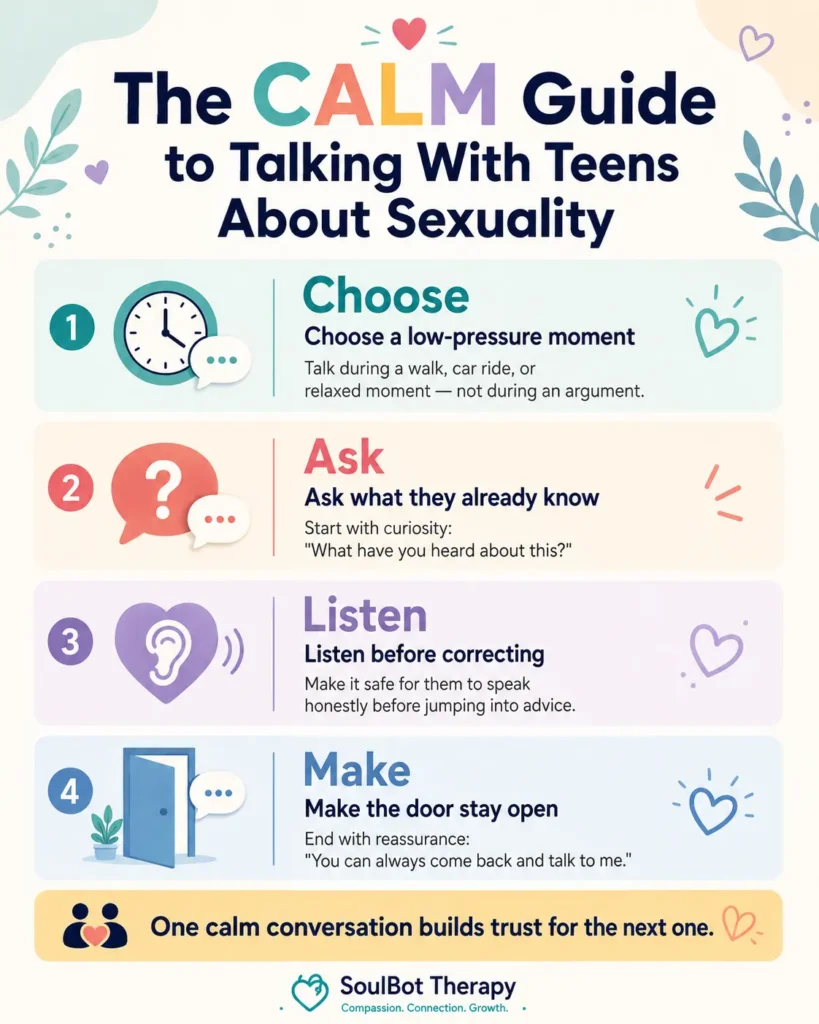
Use the SoulBot CALM Conversation Method
C- Choose a low-pressure moment
Avoid beginning the conversation during an argument or immediately after discovering something on their phone.
Better moments may include:
- while driving
- during a walk
- after watching a relevant scene
- when a news story raises the topic
Talking side by side can feel less intense than sitting face-to-face.
A- Ask what they already know
Start with curiosity:
“What have you heard about this?”
“How do people your age talk about it?”
“Does what you see online seem accurate?”
This shows you what information they already have and where misconceptions may exist.
L- Listen before teaching
Do not rush to give a speech.
Try:
“Tell me more.”
“What makes you think that?”
“How did that make you feel?”
Your reaction teaches your teen whether it will feel safe to speak honestly again.
M- Make the door stay open
You do not have to cover everything in one conversation.
End with:
“You never have to discuss something before you are ready, but you can come back to me whenever you want.”
What Teens May Ask and What You Can Say
| Teen’s question | A supportive response |
|---|---|
| “How do I know my sexual orientation?” | “You do not need to decide immediately. Pay attention to your feelings, and use a label only if it feels helpful to you.” |
| “Is it normal to feel unsure?” | “Yes. Some people know early, while others understand themselves gradually.” |
| “What if my friends do not accept me?” | “You deserve relationships where you feel respected. We can think together about who feels safe to talk to.” |
| “How do I know if a relationship is healthy?” | “A healthy relationship should include respect, consent, honesty and room to be yourself.” |
| “Did you ever feel confused?” | “I can share something useful, but I want to keep the focus on what you are experiencing.” |
If Your Teen Shares Their Sexual Orientation
The first minute matters more than having the perfect explanation.
Start with:
“Thank you for trusting me.”
“I love you.”
“You do not have to explain everything right now.”
“How would you like me to support you?”
Avoid immediately asking:
- “Are you sure?”
- “Who influenced you?”
- “Is this a phase?”
- “Who else knows?”
- “What will people think?”
Some LGBTQ+ teenagers may not be ready for others to know. The American Academy of Paediatrics advises parents to provide love and support while respecting that each young person’s process of understanding and sharing their identity is different.
Do not share their orientation with relatives, schools or friends without permission unless there is an immediate safety concern.
A Private Reflection Tool, Not a Parent-Led Quiz
If your teen asks for a private way to reflect on attraction or identity, you may share SoulBot’s Sexual Orientation Self-Discovery Test, provided it is appropriate under the test’s age and privacy terms.
Do not:
- require your teen to take it
- sit beside them while they answer
- demand to see the result
- use the result to prove or assign an orientation
A quiz cannot determine someone’s sexual orientation. It can only provide questions for personal reflection.
Private self-reflection · No forced label · Not a diagnosis
👉 Explore the Sexual Orientation Self-Discovery Test
Mistakes to Avoid
Making it one “big talk”
Teens’ questions change as they grow. Keep the conversation open rather than trying to finish it once.
Using fear as the main message
Discuss risks honestly, but also talk about respect, emotional readiness, communication and healthy relationships.
Assuming your teen is heterosexual
Use neutral language such as “someone you like” or “a future partner” unless your teen chooses different words.
Pressuring them to adopt a label
Labels can help some people feel understood, but no one should be rushed into choosing one.
Turning every question into an interrogation
A question may be curiosity, not a confession.
Answer what was asked before demanding personal information.
Trying to debate their feelings
Your teen may still be exploring. Listening does not require you to predict where that exploration will lead.
When Additional Support May Help
Consider support from a qualified adolescent therapist, paediatrician or sexuality educator when:
- your teen appears distressed or isolated
- bullying or discrimination is occurring
- family conversations repeatedly become hostile
- your teen fears rejection or being forced out of the home
- you need help separating your emotions from their needs
- there are concerns about coercion, abuse or immediate safety
UNESCO’s recent research found that well-designed sexuality education can strengthen adolescents’ knowledge of healthy relationships, communication and ability to identify unhealthy dynamics.
Prepare the Conversation With Soululu
Before talking with your teen, use Soululu to organise:
- what you want your teen to understand
- which personal reactions you need to manage
- a calm opening sentence
- how to respond without judgement
- questions that invite conversation rather than pressure
Soululu supports reflection and conversation planning. It does not replace professional sexuality education, medical guidance or adolescent mental-health care.
Final Thought
Your teen does not need you to be perfectly informed.
They need to know that questions will not cost them your love, respect or emotional safety.
Choose connection over interrogation. Share facts without shame. Listen before reacting. Then leave the door open for the next conversation.