Relationships shape how safe, seen, and supported we feel in the world.
Some relationships help us grow. Others slowly drain our energy, confidence, and emotional stability.
Understanding the types of relationships in your life isn’t about labelling people; it’s about protecting your mental health and learning what kind of connection actually supports you.
Let’s break down the different kinds of relationships, what they mean emotionally, and how they impact your mental well-being.
What Are the Different Types of Relationships?
When we hear “relationships,” we often think only of romance.
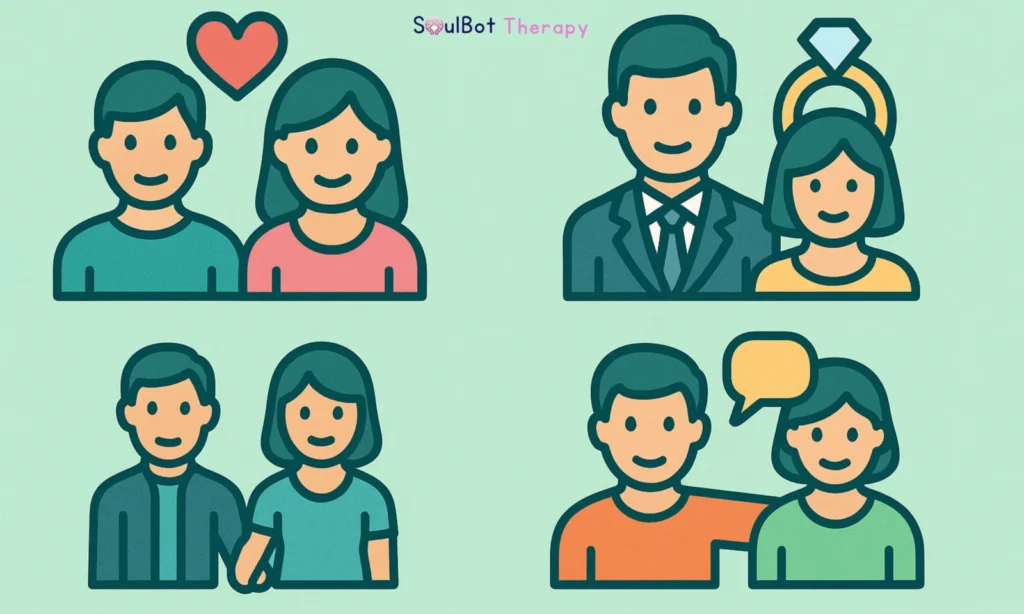
But in reality, types of relationships include:
- Romantic relationships
- Family relationships
- Friendships
- Work and professional relationships
- Casual or situational connections
- Long-term partnerships
- Emotionally defined but unlabeled relationships
Each relationship type plays a different psychological role, and each uniquely affects your mental health.
SoulFact: Research shows that emotionally supportive relationships can reduce anxiety and depression symptoms by up to 40%.
 SoulFact: Research shows that
 Healthy vs Unhealthy Relationships: What’s the Difference?
One of the most important distinctions for mental health is healthy vs unhealthy relationships.
Healthy relationships usually feel:
- Emotionally safe
- Balanced and reciprocal
- Respectful
- Supportive
- Calm, even during conflict
- Free of manipulation or fear
Unhealthy relationships often involve:
- constant anxiety or walking on eggshells
- lack of boundaries
- emotional control or guilt
- inconsistent behavior
- feeling drained after interactions
- fear of expressing yourself
Your body often knows before your mind does. If a relationship consistently dysregulates you, your mental health pays the price.
Romantic Relationships and Mental Health
Romantic relationships are deeply tied to emotional regulation and attachment.
Healthy romantic relationships support mental health by:
- Creating emotional security
- Offering consistent care
- Encouraging personal growth
- Reducing stress through connection
Unhealthy romantic relationships can lead to:
- anxiety
- low self-esteem
- emotional exhaustion
- fear of abandonment
- difficulty trusting others
Attachment styles, secure, anxious, or avoidant, heavily influence how romantic relationships affect mental health.
SoulFact: Chronic exposure to unhealthy relationship dynamics activates long-term stress responses in the brain.
Family Relationships and Their Emotional Impact
Family relationships often form our first emotional blueprint.
Supportive family relationships provide:
- Emotional safety
- Validation
- Encouragement
- A sense of belonging
Complex family relationships may involve:
- Control or criticism
- Emotional neglect
- Guilt or obligation
- Blurred boundaries
Even when family relationships are challenging, their emotional impact can last well into adulthood, shaping how you connect with others.
Friendships and Mental Well-Being
Friendships are a powerful but often underestimated relationship type.
Healthy friendships:
- feel mutual
- allow emotional honesty
- offer support without pressure
- energize you rather than drain you
Unhealthy friendships may include:
- one-sided effort
- emotional dependency
- competition or comparison
- constant negativity
Friendships that nourish your mental health leave you feeling lighter, not exhausted.
🧠SoulTip: Secure relationships help regulate the nervous system and increase emotional resilience.
Work Relationships and Psychological Health
Work relationships play a significant role in daily emotional stress levels.
Healthy work relationships:
- respect boundaries
- support collaboration
- reduce burnout
- improve confidence
Unhealthy work relationships can cause:
- chronic stress
- emotional suppression
- anxiety
- burnout
- fear of speaking up
You don’t need to love your coworkers, but you do need emotional safety to protect your mental health.
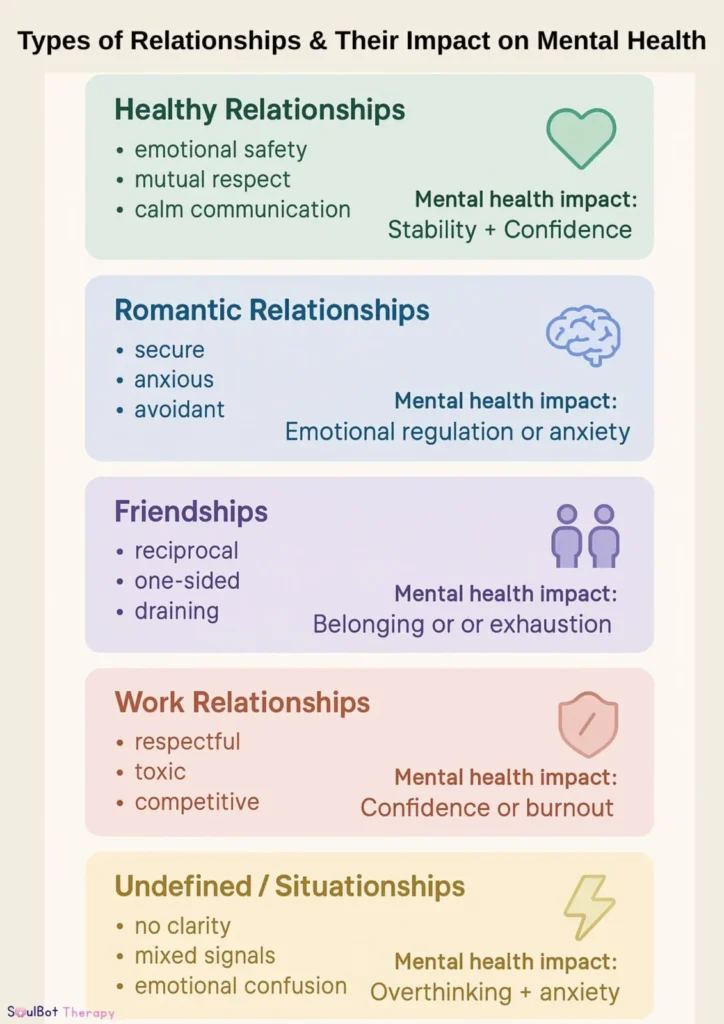
Situationships, Codependent, and Undefined Relationships
Modern relationships don’t always have clear labels.
Situationships
Connections without clarity or commitment. They often cause emotional uncertainty, anxiety, and overthinking.
Codependent relationships
Relationships where one person’s needs consistently outweigh the other’s. These can profoundly affect self-esteem and emotional balance.
Emotionally undefined relationships
Connections that feel intense but lack boundaries or direction often leave one person confused or drained. Ambiguity in relationships can quietly destabilise mental health.
How do Different Kinds of Relationships Affect Mental Health?
The emotional impact of relationships is cumulative.
Supportive relationships:
- Regulate the nervous system
- Reduce anxiety and depression
- Increase emotional resilience
- Improve self-worth
Dysfunctional relationships:
- Increase chronic stress
- Disrupt emotional regulation
- Lower confidence
- Create emotional exhaustion
How relationships affect mental health often matters more than how long they’ve existed.
How to Know Which Relationship Types Are Healthy for You?
Instead of asking “Is this relationship normal?” ask:
- Do I feel emotionally safe here?
- Can I be myself without fear?
- Do I feel heard and respected?
- Is the effort mutual?
- How does my body feel after interacting?
Patterns matter more than individual moments.
How SoulBot Helps You Understand Your Relationship Patterns?
SoulBot helps you explore your relationship dynamics by:
- Identifying emotional patterns
- Understanding attachment styles
- Reflecting on boundaries
- Tracking emotional responses
- Offering clarity without judgment
🧠 Try the Emotional Availability Test to understand how you connect.💬 Chat with SoulBot for daily guidance on building emotionally healthy relationships.