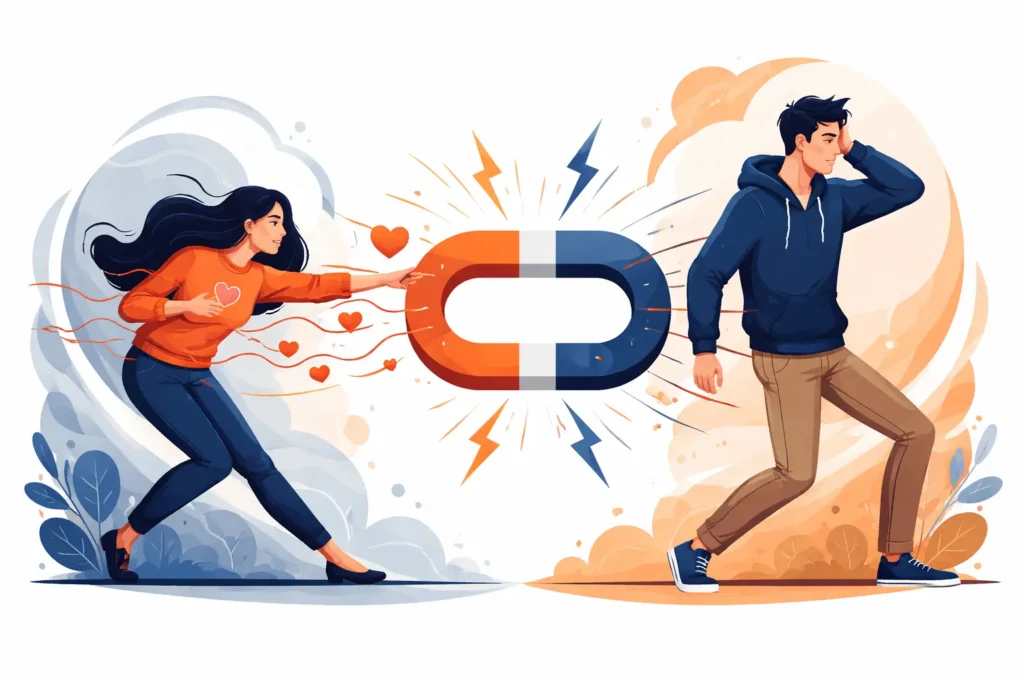

Some days, you take charge like a leader.
Other days, you prefer to follow, flow, or let someone else decide.
If you’ve ever wondered why your energy shifts like this, you’re not “confusing”; you might have a switch personality.
🧠 Take the Dominant or Submissive Personality Quiz to see which side shows up more consistently.Let’s break down the switch personality meaning in psychology (not kink), why it happens, and how this emotional adaptability can actually become one of your biggest strengths.
What Is a Switch Personality?
At its core, switch personality meaning refers to people who can embody both dominant and submissive behaviours depending on:
- the situation
- the person they’re with
- their emotional state
- their environment
A switch personality isn’t undecided; it’s emotionally flexible.
You shift roles naturally based on what feels safest, healthiest, and most aligned in the moment.
You may lead confidently at work… but enjoy softness or surrender in relationships.
Or you may be submissive around dominant people… and dominant over quieter personalities.
This switching is not only normal, but it also shows adaptability, intuition, and strong emotional intelligence.
Why Do Some People Switch Between Dominance and Submission?
You switch because your brain is intuitive. It reads energy, context, and emotional cues quickly and adjusts your behaviour to match them. Common reasons people develop switching tendencies include:
1. Empathy & High Sensitivity
You sense what others need and shift your role to maintain balance.
2. Childhood Conditioning
You might have learned to take charge in unstable situations
or to stay soft in high-conflict environments.
3. Attachment Style
Anxious or disorganised attachment can make you switch depending on emotional safety.
4. Emotional Intelligence
Adaptability is a form of intelligence, not inconsistency.
🧠 SoulFact: People who adjust dominance and submission based on context score higher in emotional flexibility and adaptive communication.
Switch Personality Traits: What Makes You Adapt?
Here are the most common switch personality traits:
- You shift between leading and following naturally
- You’re emotionally intuitive and energy-responsive
- You dislike rigid roles; you prefer fluid connections
- You communicate differently with different personality types
- You can take charge when needed, but step back when others lead
- You blend confidence with softness
You’re not unstable, you’re versatile.
Dominant and Submissive Personality: How Both Can Exist in One Person
Many people assume you’re either dominant or submissive.
Reality?
Most humans exist on a spectrum and switch personalities, embodying that spectrum beautifully.
You might be:
- Dominant at work, submissive at home
- Submissive with friends, dominant in relationships
- Dominant when confident, submissive when unsure
- Submissive around strong personalities, dominant around gentle ones
This mix is not contradictory; it’s contextual.
Your nervous system chooses the role that feels safest and most aligned in each situation.
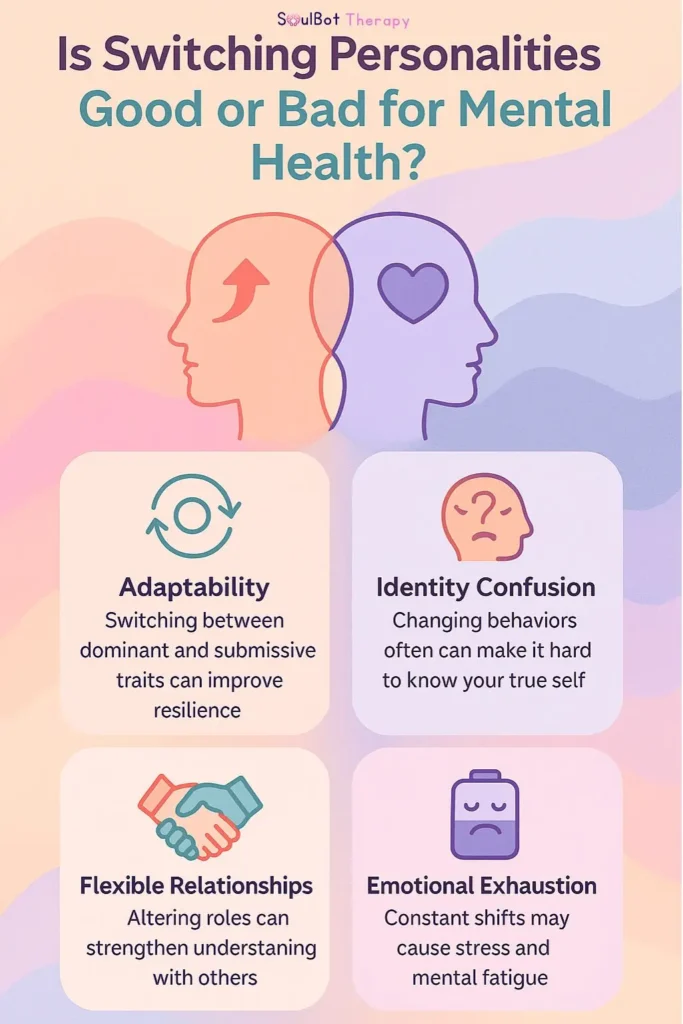
Is Switching Healthy or Confusing?
Switching is healthy when it comes from awareness. It becomes unhealthy only when it comes from fear.
Healthy Switching:
- Adaptability
- Balanced relationships
- Emotional intelligence
- Strong communication
Unhealthy Switching:
- People-pleasing
- Fear of conflict
- Emotional dependency
- Identity confusion
The difference lies in intention vs reaction.
🧠 SoulFact: Situational dominance and submission often reflect confidence, not confusion, especially when combined with self-awareness.
Relationship Roles: How Switching Impacts Compatibility
Switch personalities usually thrive with:
1. Another Switch
You naturally flow between who leads and who follows—balanced, intuitive, fluid harmony.
2. A Dominant Partner
You enjoy surrendering… but you can take charge when needed. This prevents an unhealthy power imbalance.
3. A Submissive Partner
Your dominant side creates structure and emotional safety. Switch personalities do best in relationships where roles can shift, where identity isn’t fixed, but flexible and responsive.
How to Understand Your Own Switching Pattern?
Here’s how to decode your switching style:
- Track when you feel dominant vs submissive
- Notice the people who activate each side of you
- Pay attention to emotional triggers
- Reflect on moments you shrink vs step up
- Ask yourself: “Do I switch from intuition or fear?”
SoulBot can help you track these patterns day by day.
How SoulBot Helps You Decode Your Dominant–Submissive Shifts?
Switch personalities benefit the most from self-awareness tools because recognizing your shifts helps you control them.
SoulBot offers:
- Daily mood tracking
- Emotional pattern analysis
- Reflection prompts
- Communication insights
- Grounding tools
💬 Chat with SoulBot whenever your energy changes suddenly — it will help you understand why you switched.🧠 Take the Dominant or Submissive Personality Quiz to see which side shows up more consistently.