
ESFJs are often known as the “warm-hearted helpers,” people who remember birthdays, check in when someone is struggling, and bring emotional order to chaotic spaces.
But there’s more to ESFJs than kindness. There is structure, intuition, emotional intelligence, and a deep desire for harmony that shape everything they do.
🧠 Take the MBTI Test to explore your emotional patterns.If you want a clear, human-centered explanation of the ESFJ meaning, this guide breaks down the traits, strengths, emotional patterns, relationships, and inner world of one of the most people-focused MBTI types.
ESFJ Meaning in Simple Words
ESFJ stands for:
- E — Extraverted
- S — Sensing
- F — Feeling
- J — Judging
So the real ESFJ meaning is:
👉 A warm, supportive, relationally-driven person who values connection, harmony, and responsibility.
ESFJs excel at making people feel seen, understood, and cared for.
You prioritize emotional security not just for yourself but for everyone around you. Your presence makes spaces feel safer.
👉SoulFact: ESFJs build some of the strongest long-term bonds, thanks to loyalty and emotional commitment.
Core ESFJ Traits
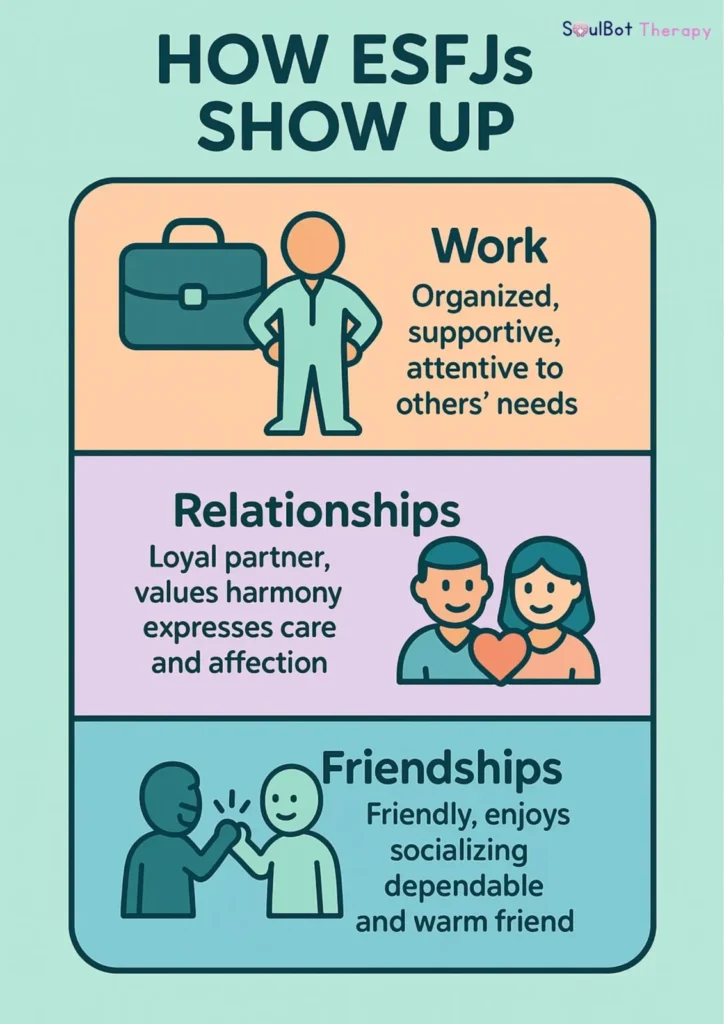
The ESFJ personality type blends emotional intelligence with practicality and structure.
Core traits include:
- strong social awareness
- nurturing and supportive nature
- highly empathetic
- excellent at maintaining harmony
- organized and dependable
- expressive communicators
- attentive to others’ needs
- detail-oriented with routines
ESFJs are often the emotional anchors in relationships and communities.
ESFJ Strengths and Weaknesses
⭐ ESFJ Strengths
- Deep emotional warmth
- Strong memory for details about loved ones
- Natural caregiving instincts
- Loyal and responsible
- Excellent communicators
- Highly attuned to others’ feelings
- Skilled at creating community and connection
⚠️ ESFJ Weaknesses
- Struggles with criticism
- Tendency to people-please
- Difficulty setting boundaries
- May avoid conflict to keep peace
- Overthinks emotional dynamics
- Can neglect their own needs
- Sensitive to how others perceive them
ESFJs grow when they learn emotional independence and self-prioritization.
ESFJ-A vs ESFJ-T: What’s the Difference?
Both types are warm and supportive, but differ emotionally.
ESFJ-A (Assertive)
- More confident
- Less likely to internalize stress
- Emotionally steady
- More decisive
ESFJ-T (Turbulent)
- Highly sensitive to others’ emotions
- More self-critical
- Overthinks relationships
- Emotionally reactive at times
Both versions share compassion; one is steadier, the other more emotionally tuned in.
How Common Is the ESFJ Personality?
ESFJs are one of the more common types.
👉 They make up around 9–12% of the population.
This explains why ESFJs often act as the emotional “glue” in families, workplaces, and friend groups.
👉SoulFact: Research shows ESFJs have some of the highest levels of emotional intelligence and social attunement among all MBTI types.
ESFJ Compatibility: Who Do ESFJs Connect With Best?
ESFJ meaning thrives in relationships where emotional openness is mutual.
Best compatibility matches include:
- ISFP — gentle emotional depth
- ISTP — grounding balance
- ESTP — excitement meets structure
- ESFP — shared warmth and energy
In relationships, ESFJs offer:
- loyalty
- kindness
- emotional support
- stability
- effort and commitment
You love wholeheartedly and practically.
Famous ESFJs (Characters & Celebrities)
Fictional ESFJs
- Molly Weasley (Harry Potter)
- Pam Beesly (The Office ESFJ/ISFJ blend)
- Hercules (Disney)
- Margaery Tyrell (Game of Thrones)
Celebrity ESFJs
- Taylor Swift
- Ed Sheeran
- Jennifer Garner
- Hugh Jackman
Known for their relational warmth and emotional intuition.
ESFJ Emotional & Communication Style
ESFJs communicate with:
- warmth
- attentiveness
- emotional awareness
- clarity
- sensitivity
Your emotional world is rich.
You feel deeply, care deeply, and think carefully about how your words affect others.
Your biggest challenge is that you often put everyone else’s emotions above your own.
Growth Path for ESFJs
ESFJs grow the most when they learn to:
- set boundaries without guilt
- Say “no” even when it disappoints people
- express their needs directly
- Stop taking responsibility for everyone’s feelings
- tolerate conflict instead of avoiding it
- reduce people-pleasing habits
- Practice self-care before burnout hits
You don’t need to be everything for everyone.
👉SoulFact: Studies reveal ESFJs experience more stress from relationship tension than any other type.
How SoulBot Helps ESFJs Thrive?
SoulBot supports ESFJs by helping you:
- Balance others’ needs with your own
- Track emotional burnout
- Set healthy boundaries
- process conflict safely
- Communicate needs clearly
- Check in with your feelings daily
💬 Chat with SoulBot for personalized ESFJ growth prompts.🧠 Take the MBTI Test to explore your emotional patterns.