Can sexuality change? If this question has ever crossed your mind, you’re not alone, and no, you’re not broken, confused, or “just going through a phase.”
Sexuality is not always fixed. For many, it’s a dynamic part of identity that can evolve with time, experience, and emotional growth.
🧠 Wondering how your emotional patterns influence attraction?
Take the Emotional Intelligence Test to understand how self-awareness and connection shape your relationships.
👉 Take the Emotional Intelligence Test
Let’s explore what sexual fluidity means, what the science says, and how you can navigate your changing feelings with confidence and compassion.
Can Sexuality Change? What Research and Psychology Say
Psychologist Dr Lisa Diamond’s longitudinal research on sexual fluidity found that some individuals, particularly women, reported changes in their patterns of attraction across years. These changes were not random or “confused” phases, but natural responses to emotional bonds, life transitions, or deeper self-awareness.
Importantly, psychology distinguishes between:
- Sexual orientation (who you’re attracted to)
- Sexual identity (how you label yourself)
- Sexual behaviour (who you have relationships with)
These three don’t always move in perfect alignment. A person’s identity label may shift even if their core attractions feel similar or vice versa.
🔄 Can Sexuality Change Over Time?
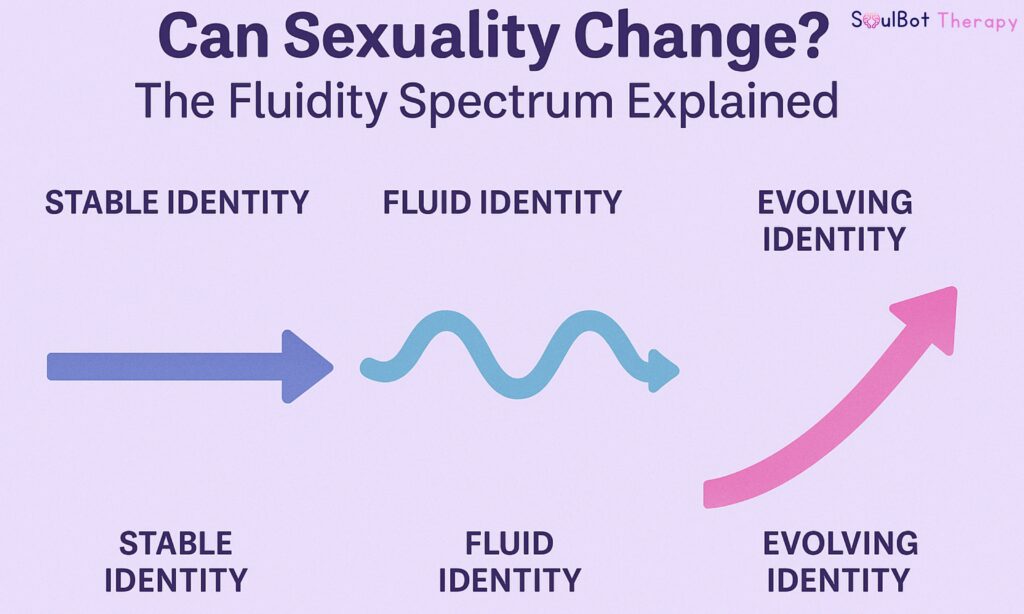
Yes, for some people, sexuality is fluid, meaning their attractions may shift over time.
This doesn’t mean someone is faking it or unsure. Longitudinal research, particularly studies led by psychologist Dr Lisa Diamond, shows that some individuals, especially women, report shifts in sexual attraction, behaviour, or identity over time.
Sexual fluidity isn’t a trend; it’s a natural human experience.
💬 What Does Sexual Fluidity Mean?
Sexual fluidity refers to the concept that sexual orientation isn’t always rigid. Instead of being locked into a fixed identity like “straight,” “gay,” or “bi,” some people experience attraction that can change depending on emotional connections, life stages, or self-awareness.
“Fluidity doesn’t make your identity less valid it makes it more real.”
Whether someone is pansexual, questioning, or just feeling different than before, that journey is worthy of recognition.
🧠 What the Research Says About Evolving Sexuality?
Psychologists like Dr Lisa Diamond, who pioneered research on sexual fluidity, emphasise that:
- Emotional bonds can play a huge role in attraction with emotional connection patterns.
- Sexuality may shift in response to meaningful life events
- Women and nonbinary people tend to report more fluidity, though it occurs across all genders
In other words, for some people, sexuality can change or evolve, and research supports that possibility.
It’s equally important to note that for many people, sexual orientation remains stable throughout life. Fluidity does not invalidate stability, and stability does not invalidate fluidity.
Is It Normal to Question Your Sexual Orientation?
Absolutely.
Questioning is often a healthy sign of growth. Many people revisit their identity in their 20s, 30s, or even 60s. You might be:
- Noticing attraction to a different gender than before
- Losing interest in past attractions
- Feeling more drawn to emotional connection than gender
All of these are valid. Labels can help some people, but if they don’t feel right, it’s okay to take your time.
🆚 Evolving Sexuality vs. Fixed Orientation
It’s important to recognise the difference:
| Fixed Orientation | Evolving Sexuality |
|---|---|
| Stays consistent over time | May shift across life stages |
| Often labeled (e.g., gay) | Often labelled (e.g., gay) |
| May feel stable from early life | May respond to emotional or relational experiences |
Both are completely valid ways to experience attraction. One is not more “real” than the other.
📚SoulFact: Recent longitudinal studies show up to 50% of women and 13–38% of men report sexual orientation shifts over time
🛠️ How to Explore Your Identity with Clarity?
Here’s how to navigate your evolving sexuality with confidence:
✅ Take your time. Identity isn’t a race.
✅ Journal your experiences. Write freely, no judgment.
✅ Talk to someone safe. A friend, mentor, or therapist can help you reflect on things.
✅ Try an exploratory quiz. Tools like SoulBot Orientation Test (coming soon!) offer private reflection.
✅ Remember: You owe no one a fixed label.
🤖 How Soululu Can Help You Understand Yourself
SoulBot offers private reflection tools for people who are questioning or exploring their identity.
Through tools like:
- 💬 Mood-based AI chats
- 🧠 Emotion-tracking
- 🧪 Orientation exploration quizzes
…our platform acts like your personal AI Coach, helping you reflect and feel seen, judgment-free.
📚 Read More
Explore evidence-based insights from the American Psychological Association to understand this subtle journey.
🌟 Final Thoughts: You Are Evolving, Not Erasing
Your feelings are real. Your attraction is real. And your evolution is real.
Whether your sexuality stays constant or shifts with the tides, the most important thing is that it’s authentic to you.
You don’t need permission to grow, just space to explore.
🌈 Still questioning where you stand?
Explore your feelings privately with SoulBot’s Orientation Reflection Test designed for safe, judgment-free self-discovery.
👉 Explore Your Orientation