If you’re confused, second-guessing your needs, or wondering whether you’re asking for too much, this blog will help you understand the difference between bare minimum vs princess treatment ettling and having healthy standards, without guilt or pressure.
Social media makes it feel like there are only two options in relationships:
Accept the bare minimum, or demand princess treatment. But genuine relationships don’t exist at either extreme.
What Is the Bare Minimum in a Relationship?
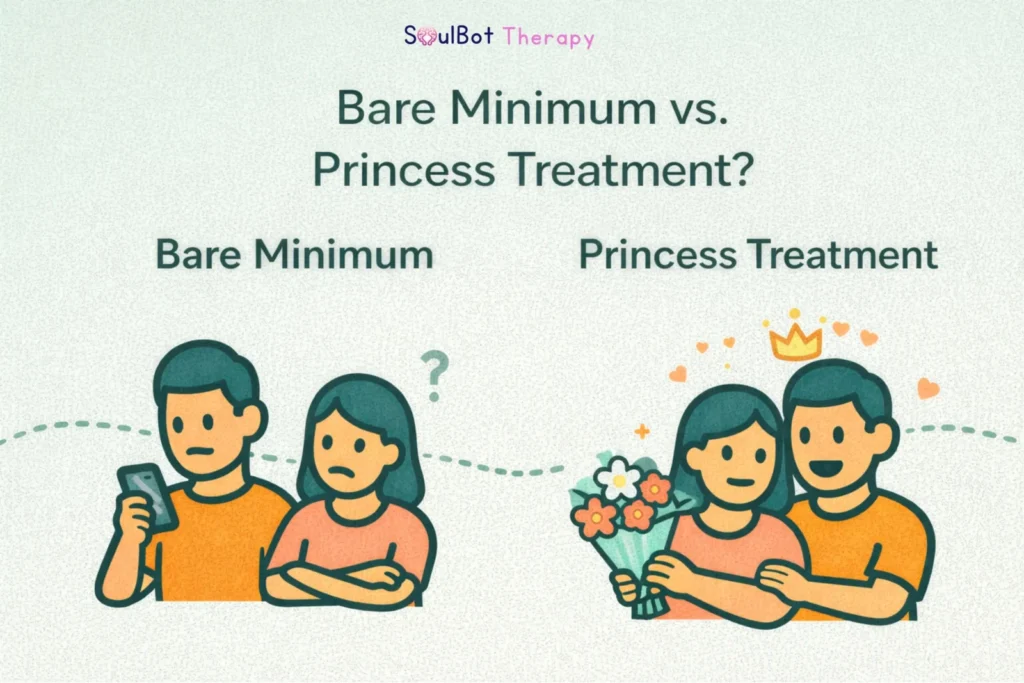
The bare minimum in relationships refers to basic human decency being framed as effort.
This includes:
- replying to messages
- showing up when promised
- basic respect
- occasional affection
- not cheating or disappearing
The bare minimum often looks like effort when emotional needs have gone unmet for a long time.
But meeting basic responsibilities is not the same as emotional investment.
SoulFact: Research shows that relationship satisfaction depends more on emotional consistency than grand gestures.
 SoulFact: Research shows that
 What Does Princess Treatment Actually Mean?
The princess treatment is often misunderstood.
Healthy princess treatment is not:
- Constant gifts
- Being financially spoiled
- Never being challenged
- Unrealistic devotion
In reality, it refers to:
- Emotional consistency
- Intentional care
- Feeling prioritized
- Reliability
- Mutual effort
Princess treatment isn’t about being put on a pedestal; it’s about feeling secure and valued.
BareMinimum vs Princess Treatment: The Real Difference
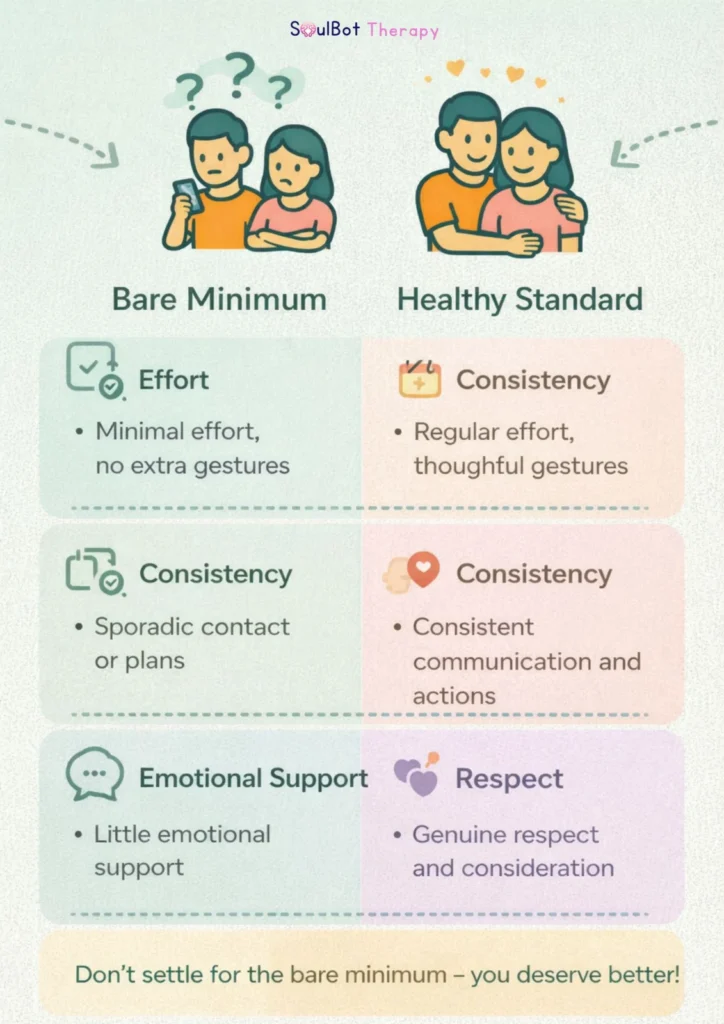
Here’s the grounded comparison most people miss with Bare Minimum vs Princess Treatment:
| Bare Minimum | Healthy Care (Not Fantasy) |
|---|---|
| Inconsistent effort | Consistent presence |
| Emotional avoidance | Emotional availability |
| You feel unsure | You feel secure |
| You justify behavior | You feel respected |
| Anxiety-driven attachment | Calm connection |
The real contrast isn’t luxury vs simplicity
It’s emotional neglect vs emotional safety.
Are Your Relationship Expectations Healthy or Unrealistic?
Healthy relationship expectations focus on how you feel, not on controlling behavior. Healthy expectations sound like:
- “I want both of us to share emotions every day.”
- “I want communication that feels safe.”
- “I want effort to be mutual.”
Unrealistic expectations often sound like:
- “They should always know what I need.”
- “They should fix my emotions.”
- “They should never disappoint me.”
Expectations become unhealthy when they replace communication or personal responsibility.
Signs You’re Settling in a Relationship
You may be settling into a relationship if you:
- Constantly explain or defend their behaviour
- Lower your needs to avoid conflict
- Feel anxious more than secure
- Accept inconsistency as “normal.”
- Fear of asking for reassurance
- Confuse attachment with love
Settling often happens quietly, not because you want less, but because you’re tired.
Signs You Might Be Asking for Too Much
On the other side, expectations may be unrealistic if:
- You expect emotional availability without giving it
- You rely on your partner to handle your self-worth
- You expect perfection from them instead of effort
- You feel entitled to continuous reassurance
- You avoid self-reflection
Wanting care is healthy. Expecting someone to meet all emotional needs alone is not.
What are the Healthy Relationship Standards That Actually Matter?
Forget extremes. These healthy relationship standards protect your mental health:
- Emotional safety
- Consistent effort
- Honest communication
- Mutual respect
- Accountability
- Boundaries
- Space to be yourself
You don’t need princess treatment. You need secure treatment.
🧠SoulTip: People who normalise the bare minimum get confused with familiarity and emotional safety.
Emotional Needs vs Unrealistic Expectations
Here’s the difference:
- Emotional needs help you feel regulated, safe, and connected.
- Unrealistic expectations try to control outcomes or people.
Needs sound like:
“I need consistency to feel secure.”
Expectations sound like:
“You must always show up perfectly.”
Healthy relationships meet needs through communication, not mind-reading.
How SoulBot Helps You Clarify What You Deserve
SoulBot helps you:
- Identify emotional needs vs validation-seeking
- Understand attachment patterns
- Rebuild self-trust
- Clarify healthy standards
- Stop normalizing emotional neglect
- Reflect without judgment
🧠 Take the Emotional Availability Test to get to know yourself better and what you truly need.💬 Chat with SoulBot for clarity when you feel stuck between Bare Minimum vs Princess Treatment.Related Blogs
- How to Overcome Resentment in Relationships?
- Healthy Relationship Signs: Am I in a Healthy Relationship?
- What Questions to Ask a Guy Beyond Small Talk?
- What are types of Relationships and What They Mean?
- Why Some People Struggle to Open Up?
- Emotionally Available vs Emotionally Vulnerable: the Difference
- What are the Signs of Emotional Unavailability?