
Wondering what the different sexual orientations are? You’re not broken, and you’re definitely not alone.
Today, sexuality is widely understood as a spectrum of attraction, not a set of fixed boxes. So when you notice yourself questioning or exploring, remind yourself you’re not being dramatic. You’re simply taking a real, honest step toward understanding yourself.
Let’s explore the beautiful diversity of human attraction, without judgment.
🌈 Want help reflecting on your attraction patterns?Take our free Sexual Orientation Test designed for compassionate self-discovery.
👉 Start the test here🌿 Soul Tip:
Your sexuality doesn’t have to stay the same forever. It’s okay to take your time, ask questions, and grow into the identity that feels authentic and safe for you.What Are the Different Sexual Orientations?
Sexual orientation refers to patterns of emotional, romantic, and/or physical attraction to others or, in some cases, little to no attraction.
Your identity goes beyond attraction. You shape it through your experiences, emotions, and where you feel at home on the evolving sexuality spectrum.
It isn’t only about who you’re attracted to. Your identity also includes:
- the language you choose
- how consistently you experience attraction
- how comfortable you feel in the identity
- how relationships and emotions shape self-understanding
Orientation isn’t a label assigned to you. It’s a reflection of your lived experiences and inner truth and it can evolve over time.
Here are a few different sexual orientations:
- Heterosexual — Some people feel attracted to a different gender that’s known as heterosexual attraction
- Homosexual — For them, attraction happens toward the same gender (e.g., a woman attracted to a woman).
- Bisexual — People who experience attraction to more than one gender
- Pansexual — And some feel attraction that isn’t influenced by gender at all
- Asexual — experiencing little or no sexual attraction
- Queer — a fluid term encompassing non-heterosexual identities
“Sexuality isn’t a checkbox it’s a living, evolving experience.”
🌈 Is Sexuality Fixed or Fluid?
Short answer: It can be both
For some people, their sexual orientation feels consistent over time. For others, it shifts, evolves, or deepens based on:
- New experiences
- Emotional growth
- Personal reflection
Fluidity is a valid, beautiful part of many people’s journey.
✅ And just like feelings shift, identity can shift too. So it’s okay if who you are now isn’t who you were before, or who you’ll be later.
How Many Types of Sexual Orientations Exist?
There’s no official “list”, and that’s a good thing.
Some common identities include:
- Demisexual — only feeling sexual attraction after deep emotional bonds
- Omnisexual — Some people feel attraction toward all genders and for them, gender does play a role in that attraction.
- Skoliosexual — attraction to non-binary or genderqueer individuals
- Graysexual — experiencing rare or situational sexual attraction
Plus, there are many more evolving self-identifications.
🧠Soul Fact: According to The Trevor Project, understanding your sexual orientation is a personal journey, and there's no "right" timeline or label it's all about what feels true to you.
Common Misconceptions About Sexual Identities
| Myth | Truth |
| “You’re just confused.” | Exploration is healthy and valid. It’s part of self-awareness. |
| “It’s just a phase.” | For some, feelings evolve. For others, they stay constant. Both are okay. |
| “You must pick a label immediately.” | You don’t owe anyone a fixed label — ever. |
| “Real sexuality only fits into 3 categories.” | Human diversity can’t be squeezed into 3 neat boxes. |
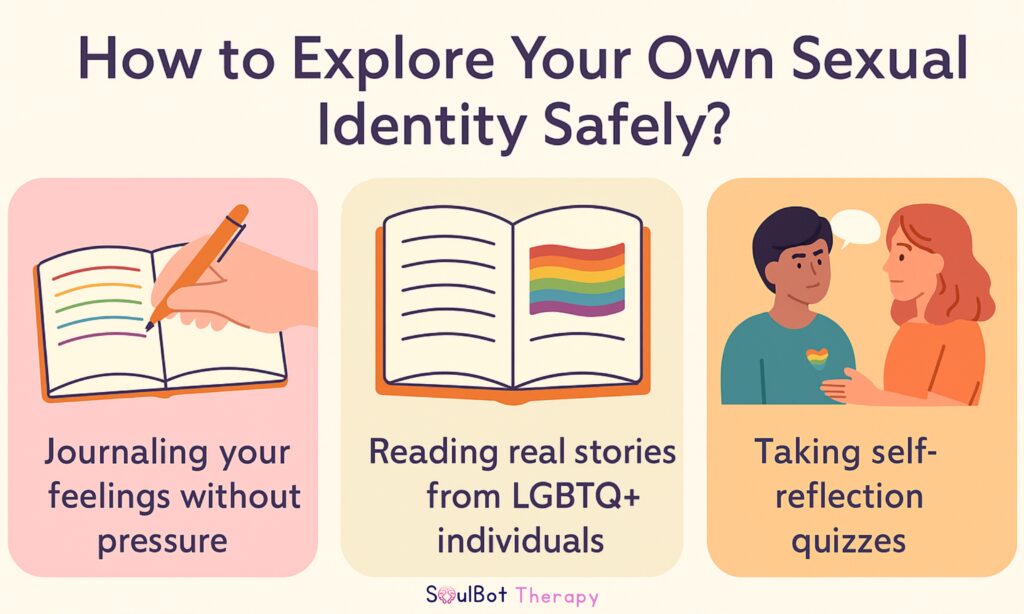
How to Explore Your Own Sexual Identity Safely?
Exploring different sexual orientations doesn’t require having all the answers right away.
✅ Safe ways to reflect:
- Journaling your feelings without pressure
- Reading real stories from LGBTQ+ individuals
- Talking to trusted friends, counsellors, or support communities
- Taking self-reflection quizzes (like SoulBot’s Orientation Quiz)
🌈 Self-exploration is personal, private, and evolving.
Why can labels help and why aren’t they mandatory?
Labels like gay, bi, pan, or queer can:
- Give you community
- Offer vocabulary for your experiences
- Make you feel seen
It’s okay to identify now… Change later…Or choose not to label yourself at all.
You get to decide what feels right for you today.
🧪Ready to Reflect? Try SoulBot Sexual Quiz
Wondering where you fall in the vast, beautiful sexuality spectrum?
Take our free, private Sexual Orientation Exploration Quiz designed to:
- Spark reflection
- Help you name your feelings if you want
- Empower curiosity, not force conclusions
Final Thought: You Don’t Have to Fit Into a Box, You Already Belong
Sexuality is a journey, not a destination.
- You can question who you are and what feels true that curiosity drives self-understanding.
- As you grow and learn, you can change, because identity evolves with experience.
- And through it all, you can exist without explanation, owning your truth on your own terms.