
- Some days you wake up tired even after sleeping.
- Some days you want to disappear for a week.
- Some days, you wonder, “Is this burnout or am I just bad at life?”
Burnout makes you doubt your ability, your stability, and sometimes even your identity. But here’s what most people don’t know:
👉 You don’t need to quit your job, abandon your responsibilities, or start a new life to recover from Burnout.
You need to recover your energy system, not your career path. Let’s break down exactly how to recover from Burnout when life doesn’t give you the luxury of pressing pause.
What Does Burnout Really Look Like?
Most people think Burnout is just being tired.
But the signs of Burnout are deeper, quieter, and more emotional:
- You feel numb instead of stressed
- You wake up already exhausted
- You feel detached from the people you love
- You can’t concentrate or make decisions
- Your patience is gone
- Even small tasks feel heavy
- You replay mistakes constantly
- You feel like you’re failing at everything
Burnout doesn’t show up as “tired.” It shows up as not feeling like yourself anymore.
Can You Recover From Burnout Without Quitting Your Job?
Yes-absolutely.
You recover from Burnout by changing how your mind and body handle stress, not by changing your entire life.
👉 Burnout isn’t a productivity problem.
It’s a nervous system overload.
When your body stays in survival mode for too long, it shuts down emotional and cognitive functions to protect you.
This is why you feel:
- foggy
- irritated
- unmotivated
- disconnected
Recovery means helping your nervous system shift back from survival → regulation.
That’s where the real healing happens.
Burnout Recovery Tips That Actually Work (Not Generic Advice)
Here are the burnout recovery tips backed by psychology and nervous system science:
1. Build micro-rest into your day (60–90 seconds)
Not long breaks, tiny resets.
Your brain recovers better in small, frequent pauses.
Examples:
- 1 minute of deep breathing
- 30 seconds of stretching
- pausing your screen + closing your eyes
- a slow sip of water while breathing
🧠 SoulFact: Micro-rest reduces stress more effectively than long gaps between tasks.
2. Stop emotional multitasking
Burnout often comes from holding too many emotions at once.
Pick ONE thing to feel or deal with at a time.
3. Name your emotions to release them
“Nervous.” “Overwhelmed.” “Disappointed.”
When you name them, you reduce nervous system overload.
4. Do a task at 60% effort (not 100%)
Perfection keeps you in Burnout.
Recovery starts with being enough, not being perfect.
5. Add a decompression ritual after stressful tasks
Think:
- shower
- walk
- quiet music
- stretching
- silence
Your brain needs a “closing tab” moment after emotional intensity.
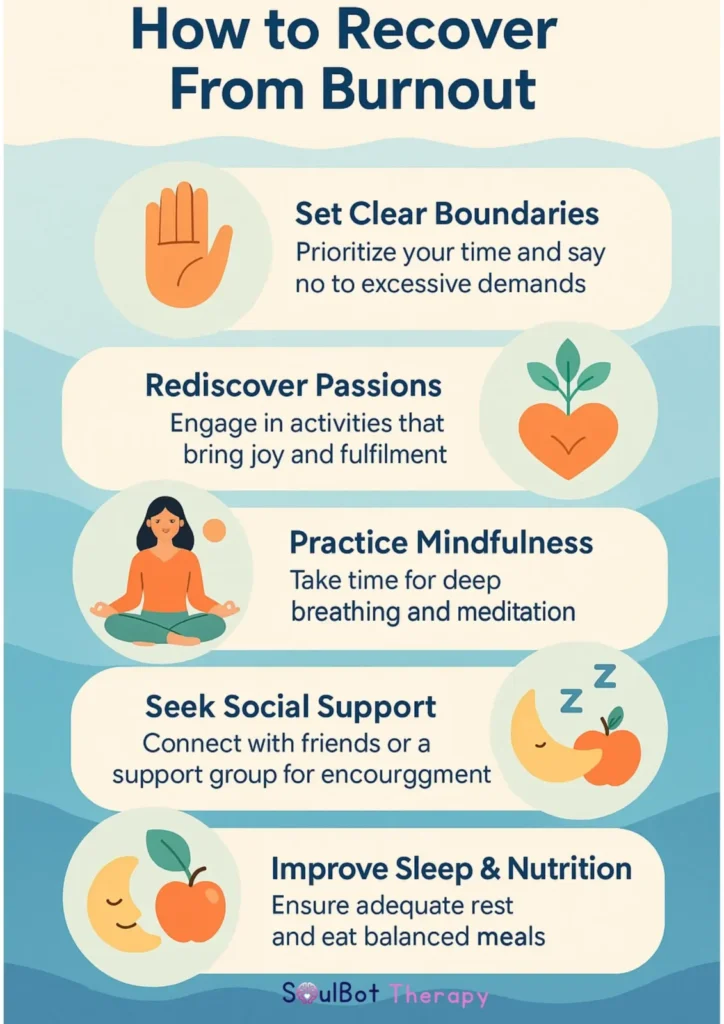
6. Set internal boundaries, not just external ones
You can’t recover from Burnout if your mind never stops working.
Internal boundaries look like:
- “I’m not problem-solving right now.”
- “This can wait.”
- “I don’t have to fix everything immediately.”
You protect your energy by protecting your mental space.
Why Emotional Exhaustion Hits Harder Than Physical Exhaustion
Physical tiredness is fixed by rest. Emotional exhaustion is fixed by expression + regulation.
Burnout drains your emotional battery faster than your physical one because:
- You’re absorbing others’ stress
- You’re carrying responsibilities alone
- You’re suppressing your feelings
- You’re constantly “on.”
How to Reset Your Nervous System When Burnout Takes Over
This creates emotional buildup that your body can’t release, so you shut down. Recognising emotional exhaustion is step 1 in learning how to recover from Burnout effectively. Burnout isn’t healed by motivation. It’s healed by regulation.
Here’s how to reset your mind and body:
1. Drop your shoulders + exhale slowly
This signals your brain that you’re safe.
2. Put your feet on the ground
Grounding stabilises your nervous system.
3. Lengthen your exhale
Breathe in for 4, out for 6.
This shifts your body out of “fight or flight.”
4. Touch something cold
Cold resets your vagus nerve and reduces overwhelm.
5. Move your body for 2 minutes
Shake, stretch, walk movement breaks the stress cycle.
🧠 SoulFact: Harvard Health found that nervous system burnout changes brain chemistry and requires regulation-based recovery, not just sleep.
Stress Management Techniques for People Who Have No Time
If you’re busy, overwhelmed, or carrying too much, these tools work:
- 1 task → 1 break → repeat
- digital boundaries after 8 pm
- low-stimulation mornings
- 10-minute “nothing time.”
- removing unnecessary decisions
- saying “no” without guilt
- protecting the first 10 minutes of your day
Stress management techniques don’t need a considerable time, just consistency.
How to Recover Mentally When You Can’t Slow Down?
Here’s how to reset your mind without quitting life:
- Write down three things that are draining you
- Please remove ONE of them for a week
- Reduce emotional noise (notifications, overthinking, people-pleasing)
- Let tasks be imperfect
- Do brain-dump journaling
- Stop carrying emotional responsibilities that aren’t yours
Burnout isn’t fixed by working harder
It’s fixed by stopping the emotional leakage.
How SoulBot Helps You Heal Burnout Without Stepping Away From Life?
SoulBot helps you recover from Burnout by:
- tracking emotional overload
- reminding you to regulate
- offering grounding tools
- guiding micro-rest
- reducing mental clutter
- helping you understand burnout triggers
- supporting nervous system resets
💬 Chat with SoulBot for daily grounding + burnout recovery support.🧠 Take the Stress Assessment Test to understand your burnout level.